Mykonos Beyond the Nightlife: Chora, Ano Mera and the Quiet Island
Mykonos has spent fifty years being famous for one thing, and the reputation has become a kind of filter. People arrive expecting a nightclub with a coastline attached, and either embrace it or brace against it. Both groups tend to miss the island.
Underneath the season, Mykonos is a small, dry Cycladic island with a long maritime history, a village that has barely changed, a working monastery, and one of the most photographed towns in Greece. None of it requires staying up late.
Mykonos Town, in the morning
Chora is at its best before ten in the morning and after the day-trippers have gone. The lanes are empty, the light is low, and the whitewash has not yet turned into glare.
The town was deliberately built as a maze — narrow, irregular streets designed to disorient raiders. Getting lost in it is not a failure of navigation, it is the intended experience. Put the phone away for an hour.
The windmills of Kato Mili
The row of round, thatched windmills on the ridge above the harbour is the island’s signature image. They ground grain for centuries, powered by the same north wind that now inconveniences ferry passengers. They stand on a small promontory looking back over Chora and Little Venice, and the view from up there at the end of the day is the reason everyone else is also up there at the end of the day.
Little Venice
A short row of eighteenth-century merchants’ houses built with their balconies directly over the water. It is small — considerably smaller than photographs imply — and it is packed at sunset. Go at midday, when it is nearly empty and you can actually see the architecture, then come back for a drink another evening knowing what to expect.
Panagia Paraportiani
By the entrance to the old castle quarter stands one of the strangest buildings in Greece: five separate chapels built into and on top of one another over several centuries, whitewashed into a single sculptural mass. It looks less like a church than something eroded by wind. It is worth ten minutes and a slow walk around all sides.
Two small museums
The Aegean Maritime Museum occupies a nineteenth-century sea captain’s house and covers Greek maritime history, with ship models, instruments and charts. Next door, Lena’s House preserves the interior of a middle-class Mykonian home from the same period, left as it was.
Neither takes long. Together they do more to explain the island than a week on the beach.
Matogianni and the galleries
Matogianni is the main artery of the old town — boutiques, jewellers, cafés and a good deal of people-watching. There are also several serious contemporary art galleries in Chora, which surprises visitors who assume the island’s cultural life ends at the DJ booth.
Ano Mera
Roughly eight kilometres east of Chora is the island’s only proper inland village. Ano Mera has a broad square shaded by plane trees, old-fashioned tavernas around it, and a pace that has nothing to do with the coast. Prices are lower and the clientele is noticeably more local.
The village is built around the Monastery of Panagia Tourliani, founded in the sixteenth century and rebuilt in the eighteenth. It has a carved marble bell tower, an elaborate wooden iconostasis and a small museum of vestments, icons and ecclesiastical silver. It is still a working monastery — dress modestly and keep your voice down.
Lunch in the square afterwards is one of the more genuinely pleasant hours available on Mykonos in August, largely because nobody is trying to sell you anything.
The Armenistis lighthouse
On the north-western headland, a few kilometres from Chora, stands a stone lighthouse built in 1891 to guard the strait between Mykonos and Tinos. It still works.
The interest is the setting rather than the building: an exposed, wind-scoured point with a long view across the channel, and a sunset that most visitors never see because they are all in Little Venice. You need your own transport, and the last stretch of road is rough.
Walking the island
Mykonos is small enough to cross on foot and dry enough that the landscape reads as almost geological — terraced fields, drystone walls, and several hundred small white chapels scattered across the hills, most of them built by families as private votives.
Walk early or late. There is no shade to speak of, and midday between June and September is not the time.
The quieter coast
Not all of the island’s beaches come with a soundtrack. The north and west coasts are markedly less developed — Agios Sostis, Fokos, Kapari and the sheltered bay at Agios Stefanos, where the sunset arrives over the water rather than behind a bar. The beaches divide fairly clearly into loud and calm, and knowing which is which changes the trip.
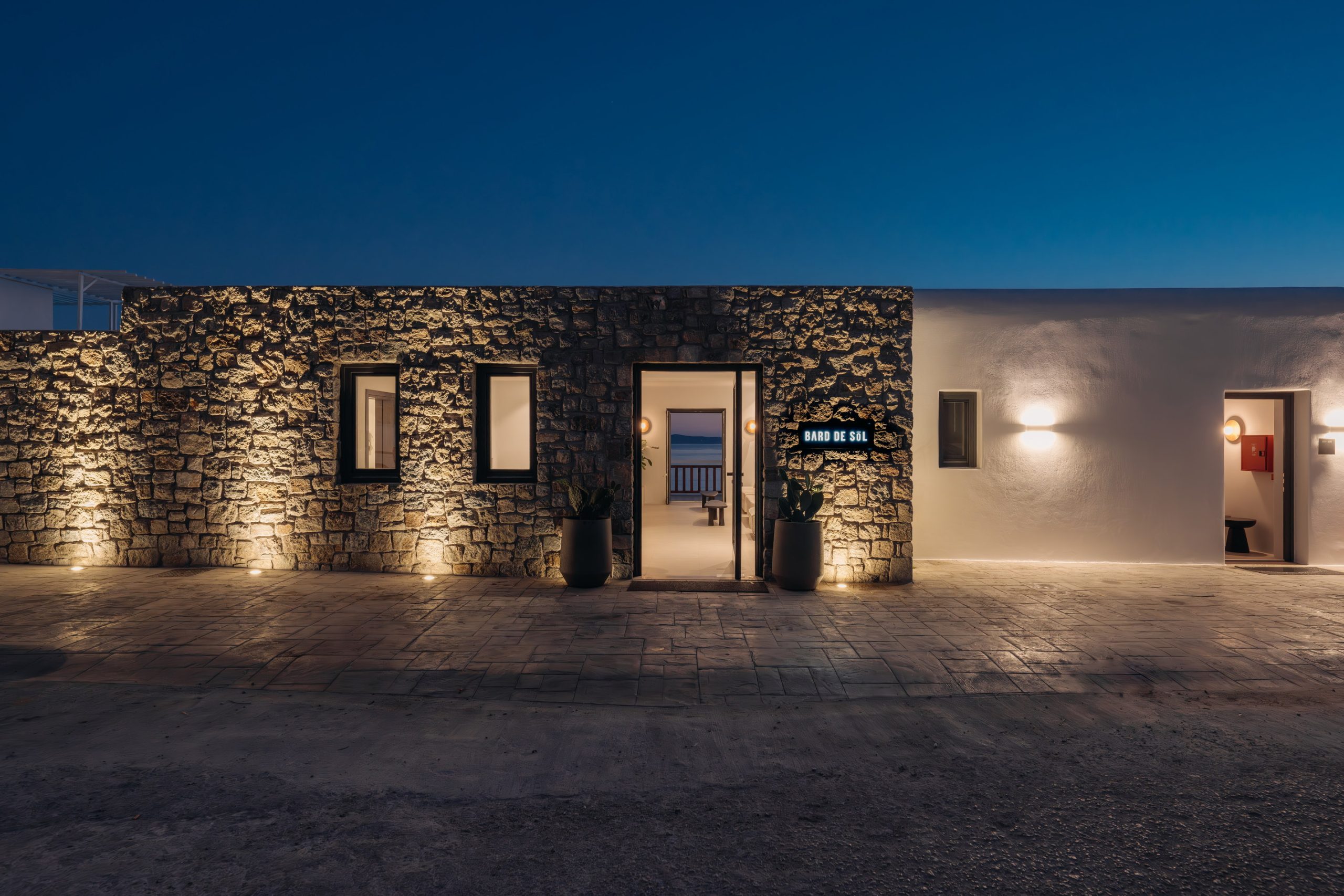
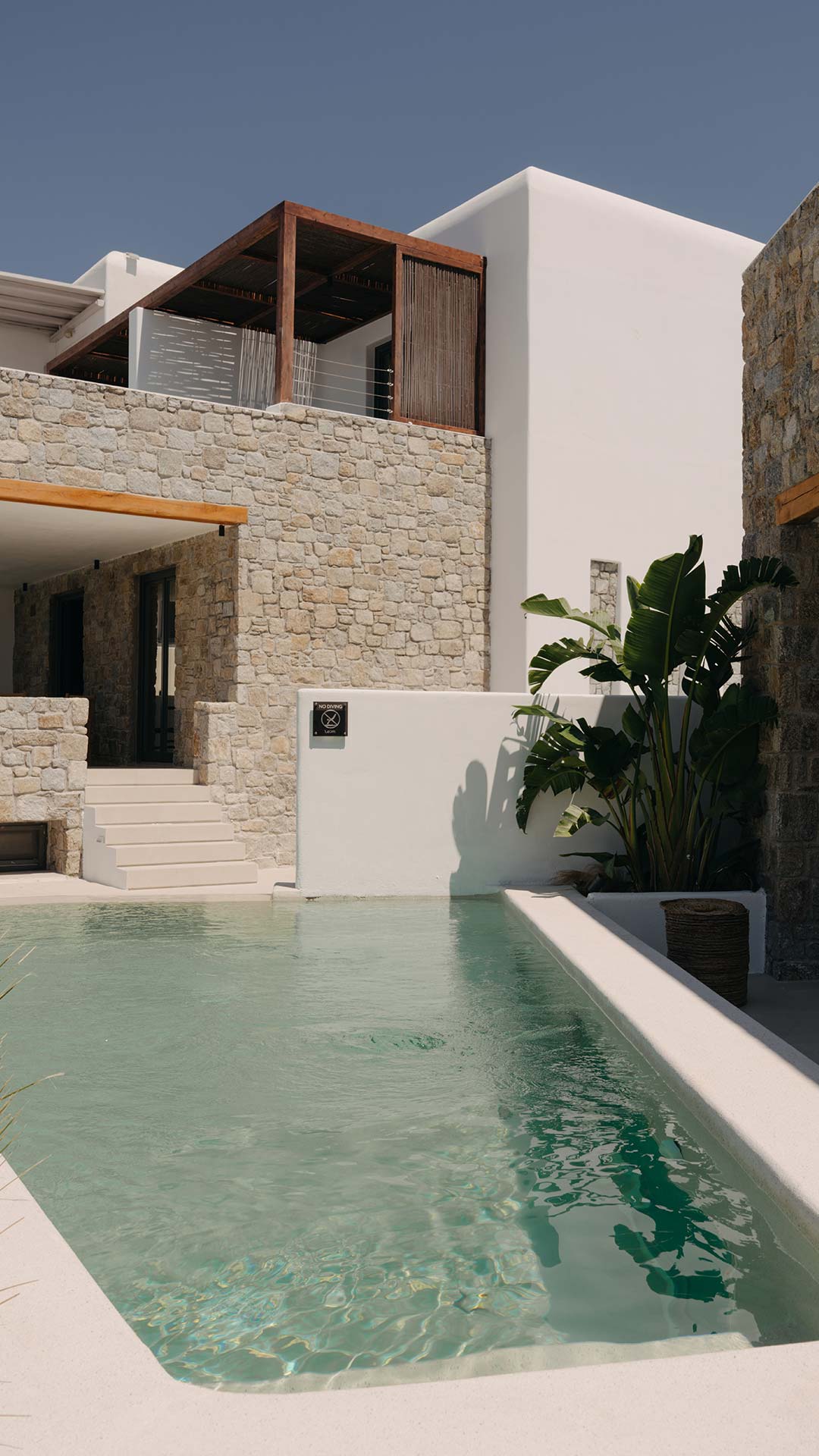
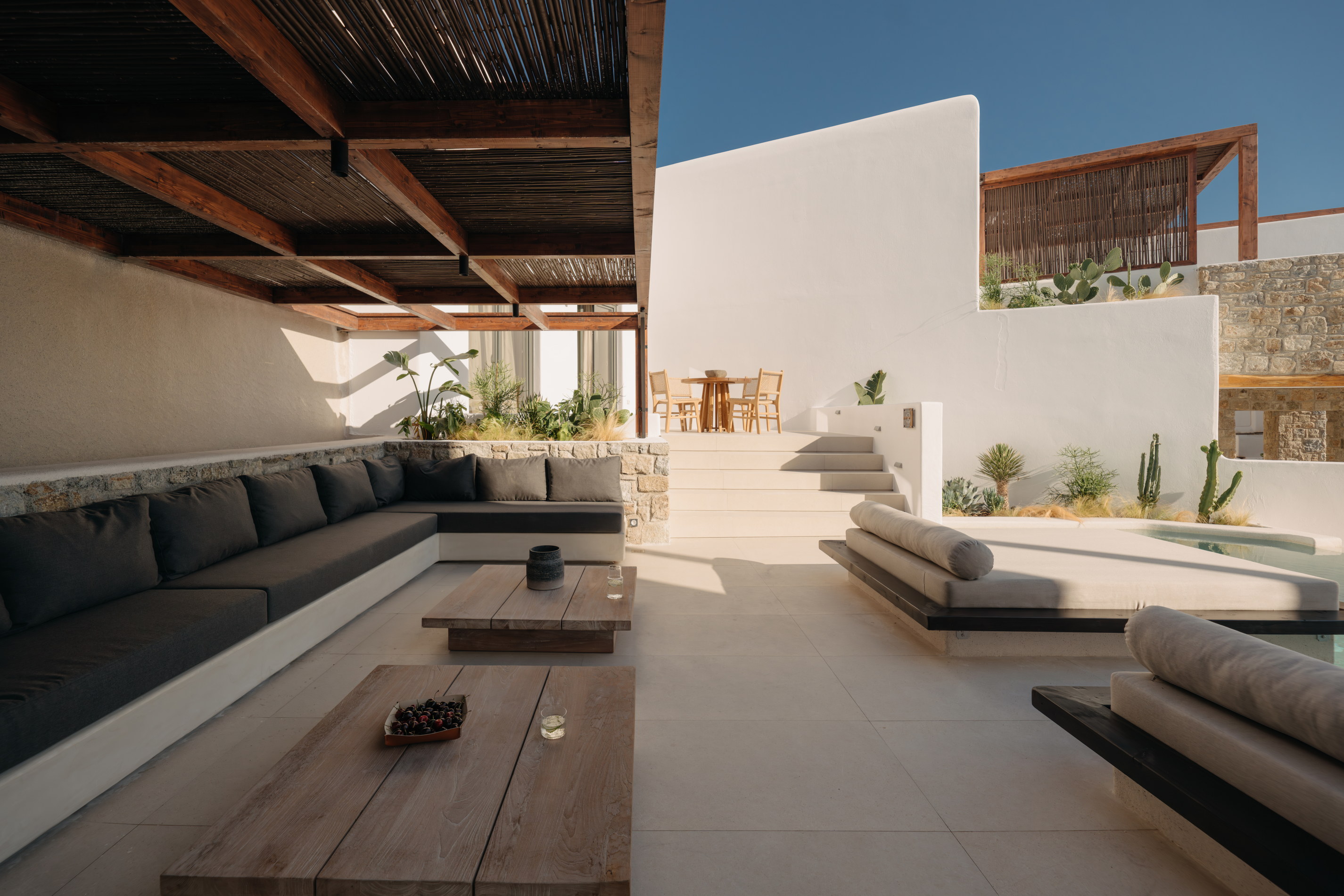
The same logic applies to where you sleep. A quiet base is not a compromise on Mykonos — it is the thing that makes the rest of the island enjoyable to visit rather than endure. Bard de Sol, a small collection of suites with private plunge pools above the bay at Agios Stefanos, is a few minutes from Chora and a considerable distance from its volume.
Delos
The one unmissable thing, and it belongs in any list of what to do on Mykonos that is not about drinking. Half an hour by boat from the Old Port lies an uninhabited island covered in the remains of one of the ancient Mediterranean’s great cities. It takes a morning and it is worth planning around.
A day without a beach
If you want one itinerary from all of the above: Chora early, for the lanes and the two museums. Ano Mera at midday, for the monastery and a long lunch. Armenistis in the late afternoon. Back into town for dinner.
That is Mykonos with the volume turned down, and it is a better island than its reputation. Where to eat along the way is a subject of its own.